
Most property managers across Auckland and Hamilton have a solid handle on the obvious compliance requirements: annual fire alarm testing, lift certifications, sprinkler system sign-offs. What tends to get less attention is the compliance layer that governs the exterior of commercial buildings, and specifically the obligations that kick in the moment someone needs to access height to carry out maintenance work.
This is not a niche area of property law. Under the Building Act 2004, building owners are required to maintain their buildings in a safe and sanitary condition at all times. That obligation does not stop at the lobby doors. Facades, anchor points, building maintenance units, and the contractors you engage to work on them all sit within a compliance framework that carries real penalties when it is not followed.
At Connect Access, we work with building owners and property managers across Auckland and Hamilton on exactly these challenges. This guide explains what that compliance framework actually looks like, where property managers most commonly run into problems, and how a properly structured approach to exterior maintenance protects both the building and the people responsible for it.
Key Takeaways
- Building owners are legally required under the Building Act 2004 to maintain their buildings in a safe and sanitary condition at all times, including the exterior
- Buildings with specified systems, including building maintenance units and height safety systems, require an annual Building Warrant of Fitness submitted to council
- Anchor points and fall-arrest systems must be re-certified annually under AS/NZS 1891.4 to remain compliant
- The Health and Safety at Work Act 2015 places duties on property managers as PCBUs when they engage contractors for height work
- Non-compliance with BWoF requirements can result in fines of up to $20,000, plus ongoing daily penalties
- Rope access is recognised by WorkSafe NZ as a compliant method for exterior height work and consistently delivers 30% to 35% savings compared to equivalent scaffolding programmes
What the Building Act Requires of Commercial Building Owners
The Building Act 2004 sets out the rules for the construction, alteration, demolition and maintenance of new and existing buildings in New Zealand. As a building owner, you are required to maintain the building in a safe and sanitary condition at all times, ensure inspection, maintenance and reporting procedures are carried out where required by any compliance schedule for specified systems, and ensure that a current building warrant of fitness is prepared and displayed.
These are not aspirational guidelines. They are legal obligations that councils actively monitor and enforce. Failure to meet these obligations carries a maximum fine of $20,000 and a further $2,000 for every day the offence continues. Councils can also issue instant fines ranging from $250 to $1,000.
For property managers operating under a management agreement, it is worth confirming clearly with building owners who carries which obligations. A property manager can be authorised to sign and submit a Building Warrant of Fitness on the owner’s behalf, but the underlying maintenance and inspection duties must have been met for that to be a valid document.
Building Warrant of Fitness: What It Covers and Where Exterior Maintenance Fits In
A Building Warrant of Fitness is an annual statement from a building owner that the building’s specified systems have been maintained and checked for the previous 12 months. It must be renewed annually and displayed prominently within the building.
Both Auckland Council and Hamilton City Council administer and audit this requirement, and non-compliance exposes building owners to prosecution under the Building Act.
Most property managers are familiar with the common specified systems: sprinklers, fire alarms, emergency lighting, lifts. What is less well known is that building maintenance units providing access to exterior and interior walls of buildings are also listed as specified systems under Schedule 1 of the Building Act.
If your building has a BMU, a gondola system, or installed track access for window cleaning or facade maintenance, that system is a specified system requiring compliance schedule management and annual Independent Qualified Person sign-off, just like any other.
Even where a building does not have a BMU, the annual BWoF process creates a natural checkpoint for property managers to review the broader condition of exterior building elements.
Facades that are deteriorating, sealants that are failing, or coatings that have broken down are often identified during this cycle, and addressing them promptly is both a maintenance obligation under the Act and a practical way to avoid larger repair costs later.
The Anchor Point Certification Requirement Most Buildings Miss
Separate from the BWoF framework but equally important is the certification requirement for permanent anchor points installed on commercial buildings. These are the fixed anchor systems used by maintenance contractors, window cleaners, and rope access technicians to access the building exterior safely.
Under AS/NZS 1891.4, all fall restraint and fall arrest anchors must be tagged and re-certified annually to remain compliant. This is a requirement that many Auckland and Hamilton property managers are unaware of until a contractor arrives on site, checks the anchor tags, and cannot legally proceed because the certifications have lapsed.
At that point, work either stops entirely or the anchor inspection needs to be completed before anything else can happen, adding time and cost to the project.
The re-certification must be carried out by a competent person. Connect Access offers harness and equipment inspections and anchor point assessments for commercial buildings across Auckland and Hamilton, which can be scheduled ahead of planned maintenance to ensure there are no delays when contractors arrive on site.
Your HSWA Obligations as a PCBU When Engaging Height Contractors
Under the Health and Safety at Work Act 2015, property managers and building owners who engage contractors for work at height are PCBUs, Persons Conducting a Business or Undertaking, and carry specific duties under the Act. You are required to identify risks and take reasonable steps to eliminate or minimise them.
For a full breakdown of the trades that qualify as height workers and the certifications they must hold, go through our guide to height workers in New Zealand.
When engaging contractors for work on elevated building exteriors, you are expected to have satisfied yourself that fall prevention systems are in place and that the contractor is operating with compliant systems, proper training, and documented risk management.
If a contractor is injured on your building because an anchor point was not certified, because a safe work method statement was not in place, or because the contractor was not appropriately qualified, the HSWA creates potential liability for the building owner or manager, not just the contractor.
WorkSafe NZ publishes best practice guidelines for industrial rope access, covering safe rope access techniques, permanent anchor design and installation, and the selection and maintenance of rope access equipment. An IRATA-certified contractor operating under those guidelines gives you a documented, defensible record that due diligence was exercised.
Connect Access technicians hold IRATA certification and are assessed under the +IMPAC Prequal Tōtika Scheme. Every project includes a completion report with photographs, which provides building owners and managers with the documentation they need to demonstrate that work was carried out safely and to standard.
The Real Cost of Deferred Exterior Maintenance
Property managers operating under budget pressure often defer exterior maintenance work, particularly painting and facade treatment, beyond the point where it makes financial sense. The logic is understandable: exterior repaints are significant expenditures and the building still looks functional even when coatings have started to fail.
The problem is that once a coating system breaks down, the underlying substrate begins to degrade. Concrete carbonation, reinforcing corrosion, and water ingress all accelerate once the protective layer is gone. What was a repainting job becomes a structural repair job, and structural repair at height is a fundamentally different cost proposition.
There is also an access cost embedded in most exterior maintenance quotes that is worth understanding before you compare options. A significant portion of the cost of exterior repainting for commercial buildings is not the paint or the labour rate, it is the access method.
Scaffolding on an Auckland or Hamilton building means permits, traffic management plans, site set-up measured in weeks, and daily hire costs that accumulate throughout the project.
In our experience across Auckland and Hamilton commercial buildings, rope access repaints typically come in 30% to 35% below equivalent scaffolding-based quotes for the same scope. The access cost is the primary reason for that gap, not the paint or the labour rate. For a full breakdown of what drives that difference, check out our complete high-rise painting guide.
How Rope Access Satisfies the Compliance Framework
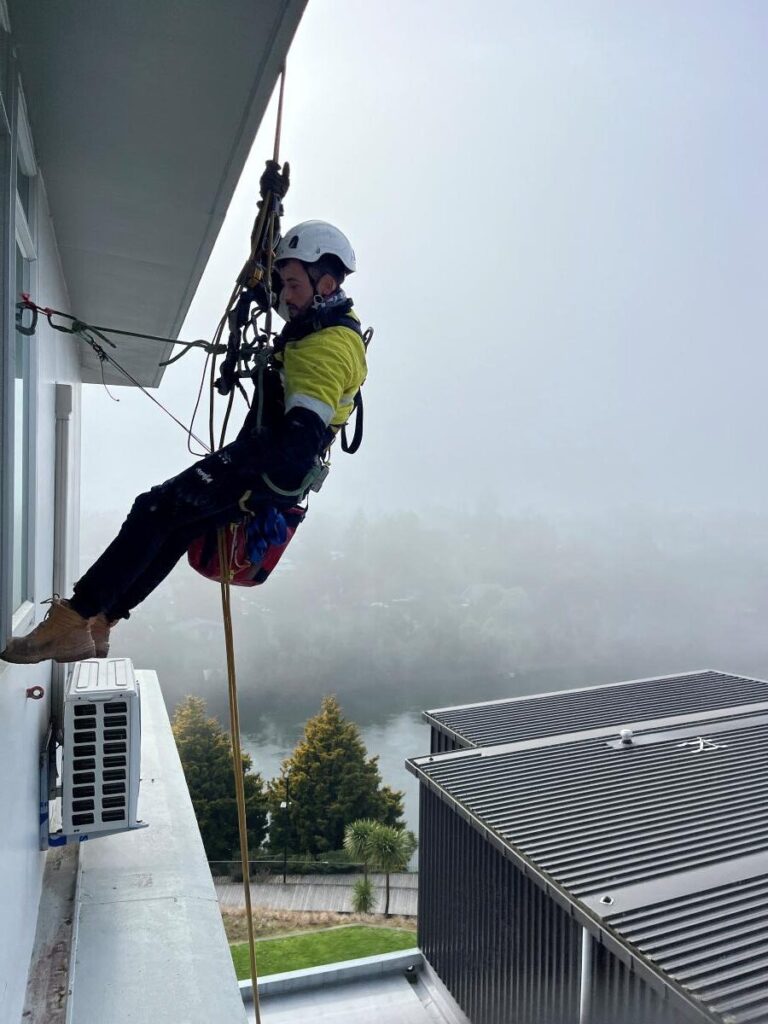
WorkSafe NZ formally recognises industrial rope access as a compliant method for exterior height work. A contractor operating under the WorkSafe best practice guidelines with IRATA-certified technicians is operating within the compliance framework the Act expects.
For property managers, this matters because choosing rope access over scaffolding is not a trade-off between cost and compliance. It is a compliant method that happens to cost significantly less and cause significantly less disruption to tenants and building operations.
The rope access and height safety systems Connect Access deploys for exterior maintenance are designed to meet the requirements that the HSWA and building compliance framework place on both the contractor and the building owner engaging them.
Technicians work from dual-rope systems to AS/NZS standards, carry site-specific safe work method statements, and complete daily pre-work checks documented as part of every project file.
Compliance Checklist: What to Verify Before Engaging a Height Contractor
IRATA certification at the appropriate level for the work being undertaken. Every technician descending your building facade should hold current IRATA certification, which requires annual revalidation and rescue competency assessment at every level.
+IMPAC Prequal Tōtika Scheme assessment provides independent verification of the contractor’s health and safety management systems, removing repetitive vetting for property managers overseeing multiple sites.
Anchor point certification status for your building. If your anchor points have not been re-certified in the past 12 months under AS/NZS 1891.4, confirm this is addressed before work begins.
Site-specific safe work method statement provided before work commences. A SWMS should be specific to your building, not a generic template.
Current public liability insurance of at least $10 million for commercial work, and up to $20 million for larger or higher-risk sites such as shopping centres, which often specify this as a minimum requirement. Request copies rather than accepting verbal confirmation.
Completion report with photographic evidence confirming work completed to the agreed standard. This documentation protects your position for insurance and compliance purposes.
A Practical Approach for Auckland and Hamilton Property Managers
The most common gap we see is reactive rather than proactive maintenance. Buildings get painted or cleaned when the condition becomes impossible to ignore, rather than on a cycle that keeps coatings in good condition and prevents substrate damage.
A simple annual review covering anchor point certification status, exterior coating condition, and facade integrity takes a fraction of the time of dealing with a reactive repair. For buildings that have multiple maintenance needs coming up, bundling exterior work through a single rope access mobilisation is almost always more cost-effective than addressing each element separately as it becomes urgent.
Connect Access works with property managers and building owners across Auckland and Hamilton on high-rise painting, building maintenance, anchor point certification, and specialist height access work. Every project is completed with a full photographic report and a detailed record of work completed.
If you are reviewing your building’s exterior maintenance schedule, or if you have a specific access challenge that conventional contractors have struggled to quote competitively, get in touch with the Connect Access team for a no-obligation assessment.
Call 0274 571 077 or email brendon@connectaccess.co.nz to discuss your building.