
Most property managers know their building’s windows need cleaning. What is less clear is how often, using what method, and what they are actually responsible for when they engage the contractor.
At Connect Access, we carry out high-rise window cleaning across Auckland and Hamilton, and these are the questions we get asked most. This guide covers the practical answers, specific to Auckland’s buildings and climate.
Key Takeaways
- Auckland buildings in coastal and CBD locations typically need exterior window cleaning two to four times per year, depending on height, location, and exposure
- Taller and more complex facades require rope access or suspended platform systems, not ground-based equipment
- WorkSafe NZ requires permanently installed anchor points to be tagged and re-certified annually under AS/NZS 1891.4 before any rope access contractor can use them
- A professional contractor should provide a site-specific safety plan before work starts and a written completion report with photographs afterwards
How Often Does an Auckland High-Rise Need Its Windows Cleaned?
There is no universal answer, but there are consistent patterns across Auckland’s commercial buildings.
Most CBD commercial buildings benefit from two exterior cleans per year. This addresses the mould and algae growth that accumulates over winter and the salt film that builds up through the warmer months when wind off the Waitemata carries marine air across the city.
Waterfront buildings and those on exposed elevated sites see higher salt deposition. Properties along the North Shore waterfront, Wynyard Quarter, and the CBD’s eastern fringe toward the port typically need three to four cleans per year to prevent salt accumulating to the point where it becomes harder to remove and begins to affect glass condition.
Inland commercial areas like Mt Wellington, Penrose, and East Tamaki have lower salt exposure and generally maintain good presentation on two cleans per year, though industrial airborne particulate in these locations creates its own contamination.
The right starting point for any building without a documented cleaning history is to commission a condition assessment alongside the first clean. This gives you a baseline record and lets the contractor recommend a frequency based on what is actually on the glass rather than a generic schedule.
What Auckland’s Climate Does to Building Glass
Three types of contamination are common on Auckland commercial glass, and understanding them explains why frequency matters.
Biological growth, mould, lichen, and algae establish on glass surfaces that stay damp, particularly on aspects that get morning dew without strong afternoon sun. Once established, biological matter bonds to the surface and requires more effort to remove than fresh contamination would have.
Salt film from windborne marine air is a continuous process in coastal and harbour-adjacent locations. At low concentrations it creates haze. At higher concentrations over time, particularly on exposed buildings, it can contribute to surface damage if not regularly washed off.
Mineral deposits form where water contacts the glass and then evaporates, whether from irrigation systems, air conditioning condensate, or runoff from building elements above. These require different treatment from biological or salt contamination.
All three are easier and less costly to address when they are caught early. A building on a consistent cleaning programme avoids the remediation cost of glass that has been neglected for several years.
Access Methods: What Actually Happens on Site
The cleaning method determines how safely the work can be done, what result is achievable, and what compliance obligations apply.
For lower-rise buildings where the full facade can be reached effectively from the ground, water-fed pole systems are a practical option. Purified water is delivered through an extended carbon fibre pole to a brush at the top, agitating and rinsing the glass without a technician leaving the ground. Because purified water is used, it dries spot-free without squeegee work.
For taller or more complex buildings, the work must be done from above. The two main compliant methods in New Zealand are industrial rope access and suspended platform systems. WorkSafe NZ endorses industrial rope access as a compliant work-at-height method when carried out by certified technicians operating under its best practice guidelines.
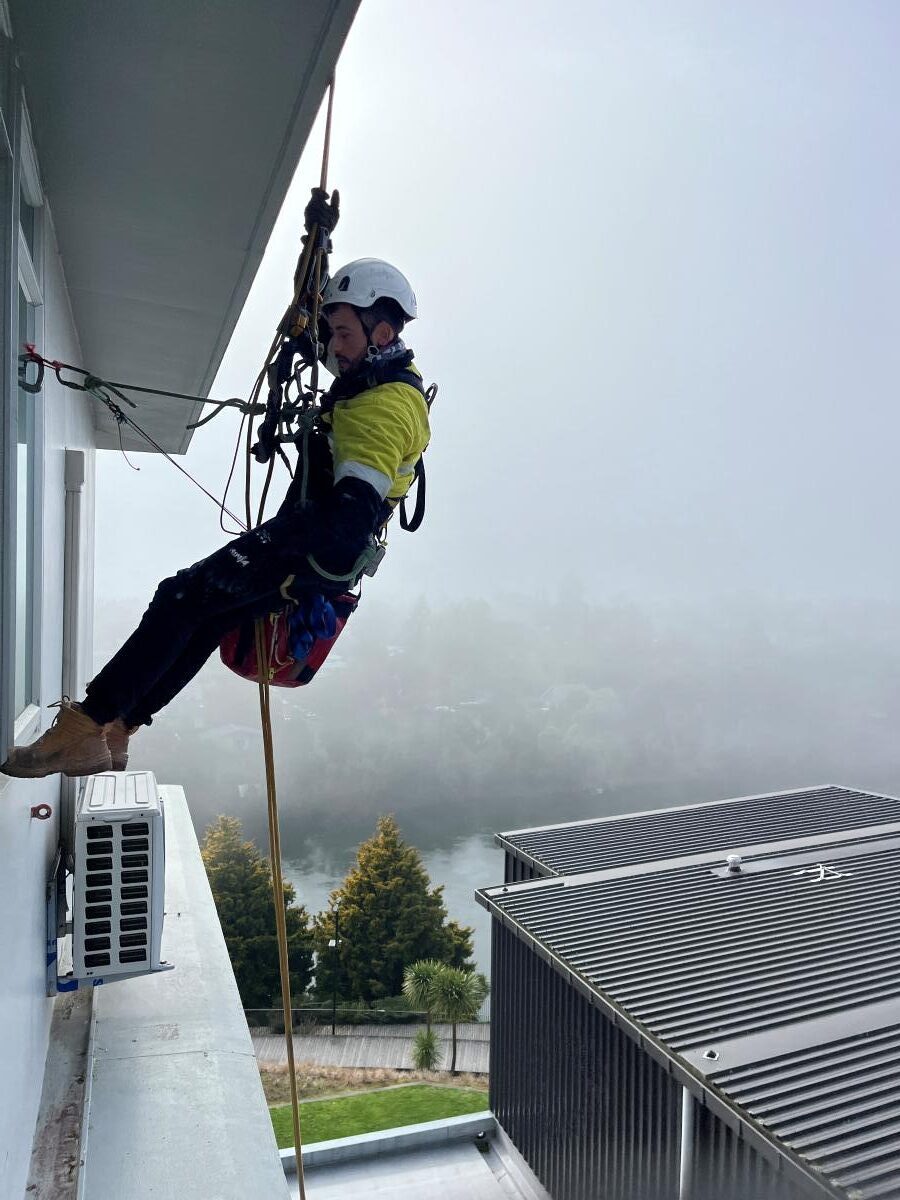
Rope access is generally the more efficient option for most Auckland high-rise buildings. IRATA-certified technicians descend on a dual-rope system from anchor points at roof level, cleaning each elevation systematically.
The method provides access to complex facade geometry, recessed windows, and architectural features that a gondola or bosun chair cannot always navigate. Set-up is minimal relative to the scale of the work, and there is no obstruction at ground level beyond a managed zone directly below.
For rope access to proceed, your building’s permanently installed anchor points must be certified within the past twelve months. More on this below.
What Drives Cost on a High-Rise Window Clean
Understanding what goes into a quote helps you compare them accurately and identify when a lower figure reflects a reduced scope rather than a more competitive contractor.
Building height, total facade area, glass configuration, and access complexity are the main variables. A building with straightforward curtain wall glazing takes less time than one with recessed windows, projecting features, or a roofline that makes rigging more involved. Two buildings with the same number of floors can have meaningfully different cleaning costs.
Access method is a significant driver. Rope access work at height carries higher labour and compliance costs than ground-based work. This is a real cost difference, not a margin difference. For a detailed breakdown of how rope access and scaffolding compare on cost, see our scaffolding versus rope access cost guide.
Scope matters when comparing quotes. Some cover glazing panels only. Others include frames, sills, reveals, and the building base. A quote covering only the glass can appear more competitive than one covering the full scope, but the comparison is not accurate if the specification differs.
Finally, contractor familiarity affects cost over time. A contractor with established site records, rigging diagrams, and knowledge of your building’s access characteristics works more efficiently than one starting from scratch. Ongoing programmes with a single contractor typically cost less per clean than repeated one-off quotes.
What a Good Contractor Delivers Beyond Clean Glass
Before work begins, a professional contractor should provide a site-specific safe work method statement for your building. As set out in the WorkSafe NZ best practice guidelines for industrial rope access, a health and safety plan is a required part of any rope access operation.
This document should cover the rigging approach, anchor points to be used, working zones, pedestrian management, and emergency procedures for your specific site, not a generic template with your address filled in.
Confirm that attending technicians hold current IRATA certification. IRATA requires 3-year revalidation including rescue competency. A professional operation can confirm technician certification levels without hesitation.
After the work, ask for a written completion report with photographs. This protects your position, gives you a record of the building’s condition at that point in time, and creates a natural opportunity for the contractor to flag any maintenance issues they observed on the facade while working.
Compliance: What to Confirm Before You Book
If your building has permanently installed anchor points, confirm their certification status before scheduling any rope access work. WorkSafe NZ is explicit that all fall restraint and fall arrest anchors must be tagged and re-certified annually under AS/NZS 1891.4. A WorkSafe safety alert also places this obligation directly on PCBUs who have control over buildings with permanently installed height safety systems.
If certifications have lapsed, a contractor cannot use those anchors until they have been inspected and re-certified. Finding this out on the day the work is scheduled adds time and cost. Confirming anchor status beforehand avoids that.
Also confirm the contractor holds adequate public liability insurance for commercial high-rise work and ask for documentation rather than taking verbal confirmation.
For a full overview of your obligations when engaging height contractors, including your PCBU duties under the Health and Safety at Work Act 2015 and your Building Warrant of Fitness responsibilities, get in touch with us and we can walk you through what applies to your building.
Working With Connect Access
We provide high-rise window cleaning and building washing for commercial properties across Auckland and Hamilton. Our IRATA-certified technicians work on dual-rope systems with a site-specific safe work method statement on every project. Every clean includes a written completion report with photographs and notes on any facade maintenance issues observed during the work.
We work around building operations without disrupting tenants, staff, or ground-level access. For buildings with multiple maintenance needs in the same period, combining a window clean with other rope access work in a single mobilisation is usually more cost-effective than booking each task separately.
Get in touch with the Connect Access team for a no-obligation discussion about your building’s requirements.
Call 0274 571 077 or email brendon@connectaccess.co.nz.
Frequently Asked Questions
Most central Auckland commercial buildings benefit from two exterior cleans per year as a starting point. Waterfront and coastal-exposure buildings typically need three to four cleans annually. The right frequency for any building depends on its location, orientation, height, and facade type.
Confirm the certification status of your building’s permanently installed anchor points. WorkSafe NZ requires these to be re-certified annually under AS/NZS 1891.4. If certifications have lapsed, work cannot proceed until anchors are inspected and re-certified.
The primary driver is access method. Rope access requires IRATA-certified technicians, rigging from roof level, site-specific safety planning, and specialist equipment. This carries a higher cost base than ground-level work, regardless of who carries out the job.
A written completion report with photographs confirming work was completed to the agreed specification. A thorough contractor will also note any facade maintenance issues observed while on the ropes, such as failing sealant or areas of coating breakdown.
Yes. WorkSafe NZ endorses industrial rope access as a compliant work-at-height method. Engaging an IRATA-certified contractor who operates under the WorkSafe best practice guidelines, with a site-specific safety plan and confirmed anchor certification, gives you a documented record that work was carried out within the framework WorkSafe expects.

