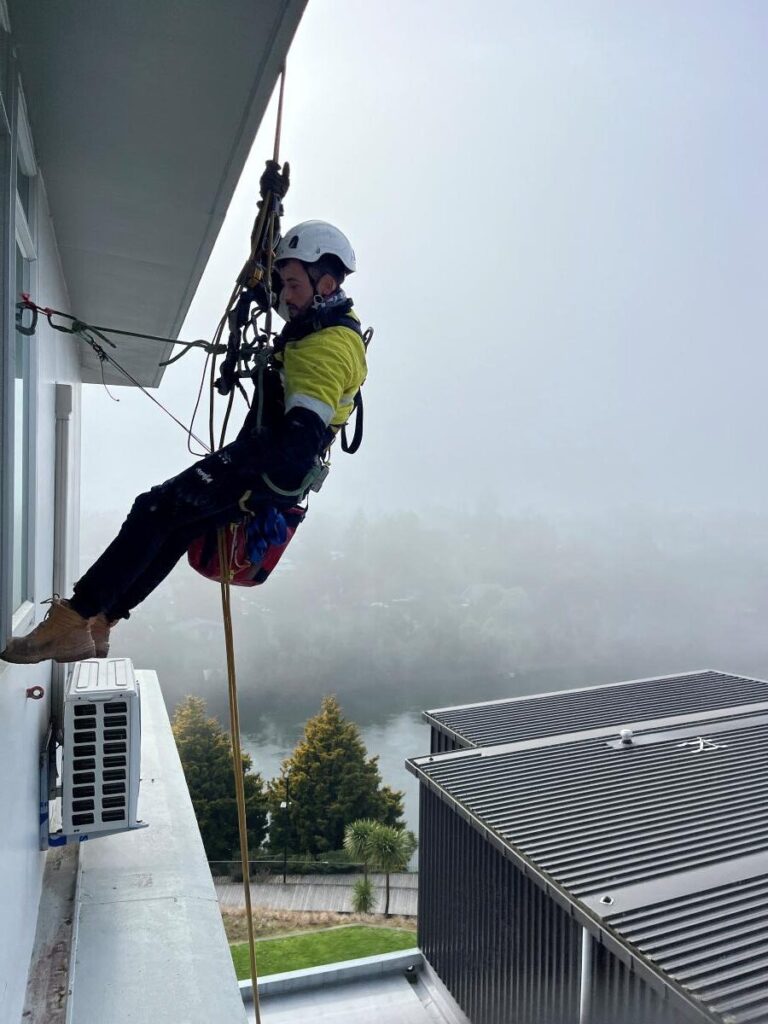

If your building, plant, or industrial site has anchor points, static lines, or a rail system installed for working at height, it’s easy to assume that once they’re bolted in and certified, the job is done. It isn’t. Height safety anchors are safety-critical equipment exposed to UV, corrosion, vibration, and structural movement year-round, and New Zealand’s standards treat them the same way you’d treat a harness or a lanyard: something that needs to be checked, tested, and re-certified on a set schedule, not left alone until something goes wrong.
This article breaks down how often height safety anchor inspection and anchor certification in NZ is actually required, what a proper inspection covers, who’s allowed to carry one out, and what happens if you let it lapse.
Why Anchor Inspections Matter More Than People Think
Working at height remains one of the most consistently dangerous categories of work in New Zealand. Falls from height are a leading cause of serious harm on construction and maintenance sites, and a large share of those incidents happen from surprisingly low elevations. An anchor point is the one piece of equipment a worker’s life depends on the moment a fall arrest system is loaded — if it has corroded, loosened, or was never installed to spec in the first place, the rest of the system doesn’t matter.
That’s why height safety system inspection isn’t treated as optional maintenance. It’s a legal and practical necessity for any building owner, facilities manager, or PCBU (person conducting a business or undertaking) who has height safety infrastructure installed on their site.
The 12-Month Rule: What NZ Standards Actually Require
Under New Zealand’s governing standard, AS/NZS 1891.4, permanently installed anchor points, static lines, lifelines, and rail systems used for fall protection must be inspected and re-certified at least once every 12 months by a competent person. WorkSafe New Zealand’s guidance on maintaining, inspecting and re-certifying permanent anchorage systems confirms that permanent anchorage and lifeline systems should be inspected and re-certified at least annually by a competent person, forming part of the site’s overall maintenance and inspection programme, and carried out in accordance with the manufacturer’s instructions or the relevant sections of AS/NZS 1891.4:2009.
The same guidance notes that the person carrying out the recertification should be shown documentation confirming the system was originally designed and approved by a Chartered Professional Engineer — a detail that trips up a lot of building owners who inherited a system from a previous owner or developer with incomplete paperwork.
WorkSafe’s Best Practice Guidelines for Working at Height in New Zealand go a step further on the anchor hardware itself, recommending a minimum rated load of 15 kN and confirming that all fall arrest and abseil anchors should be tagged and recertified annually to remain compliant with AS/NZS 1891.4.
In short: if it’s been close to (or more than) 12 months since your last roof anchor recertification, your system is likely no longer compliant, regardless of how it looks from ground level.

What Happens During a Height Safety System Inspection
A proper height safety equipment inspection is not a quick visual glance from a ladder. A thorough inspection and recertification typically includes:
- Visual assessment of every anchor point, static line, rail, and lifeline component for corrosion, cracking, deformation, or wear
- Physical and torque checks on fixings and base plates to confirm nothing has loosened from vibration or structural movement
- Load testing, where required, using calibrated hydraulic or mechanical test equipment to confirm the anchor can still hold its rated capacity
- Signage and tagging checks to ensure anchors are correctly labelled with safe working loads, expiry dates, and system identification
- Documentation review, cross-referencing the system against original engineering design, layout drawings, and prior inspection records
- A written compliance report, detailing findings, test results, any defects, and recommended remedial action
If a defect is found, the anchor or system component should be taken out of service and either repaired or replaced before it’s used again. This is also where anchor installation and certification overlaps with recertification — if a system fails inspection, remedial installation work often needs to be re-certified from scratch, not simply patched and signed off.
Don’t Confuse This with Harness and PPE Inspection Cycles
One source of confusion worth clearing up: anchor points and PPE run on different inspection clocks. Personal fall arrest equipment — harnesses, lanyards, connectors and similar gear — falls under the AS/NZS 1891 series and generally requires formal inspection by a competent equipment inspector every six months, on top of the pre-use checks a worker does every time they clip in. Permanently installed anchors, static lines and rail systems are the ones on the 12-month cycle under AS/NZS 1891.4.
If your site has both permanent anchors and a pool of harnesses, lanyards or fall arrest devices in circulation, they need to be tracked separately. Connect Access runs six-monthly harness and equipment inspections alongside annual anchor recertification, so both schedules stay current without one falling through the cracks.
Who’s Qualified to Inspect and Recertify Anchors?
This isn’t a job for general maintenance staff or a building manager with a torque wrench. Recertification needs to be carried out by a demonstrably competent person, which in practice usually means technicians with formal height safety and rope access qualifications — commonly IRATA-certified rope access technicians or SARNZ-certified operators, working under a documented height safety system supervision process.
Industrial abseilers are particularly well suited to this work because anchor points are frequently located on roof edges, parapets, façades, and structures that are difficult or unsafe to access by ladder or scaffold. A rope access approach lets technicians reach every anchor on a large commercial or industrial roof in a single mobilisation, without the cost and disruption of scaffolding, while still carrying out full load testing and documentation to standard.

What Happens If You Skip Recertification?
The most immediate impact is practical: contractors working at height on your building — painters, window cleaners, façade specialists — will generally refuse to clip into an anchor with an expired or missing tag. That means routine maintenance stalls on the day, rather than being caught ahead of time.
There’s also a compliance dimension. Engaging contractors to work at height on your building puts you in the position of a PCBU under health and safety law, with duties that extend to the condition of the anchor systems those contractors rely on. We’ve covered those obligations in more detail in our guide to height workers, qualifications and regulations in NZ if you want the fuller picture of what building owners are on the hook for.
Signs Your Anchors May Need Attention Sooner
While annual recertification is the baseline, some situations call for an inspection outside the normal cycle:
- Visible rust, staining, or corrosion around anchor plates or fixings
- Any incident where an anchor has arrested a fall or taken a significant load
- Building alterations, re-roofing, or façade work near existing anchor points
- Missing, damaged, or illegible anchor tags and signage
- No available documentation confirming the last certification date
If any of the above applies to your site, it’s worth arranging an inspection regardless of when the last one was completed.
Keep Your Site Compliant with Connect Access
Connect Access is a Hamilton-based team of IRATA-certified rope access technicians and industrial abseilers, working across Auckland and Waikato on rope access, height safety systems, and industrial access projects. Our height safety services cover anchor installation and certification, ongoing height safety system supervision, and full inspection and recertification programmes for commercial and industrial sites — carried out to AS/NZS 1891.4 with detailed compliance reporting on every job.
If it’s been close to 12 months since your last anchor inspection, or you’re not sure your system has ever been formally certified, don’t wait for a contractor to find out on-site. Get in touch with Connect Access for a free quote on height safety anchor inspection and recertification, or call 027 457 1077 to talk to the team directly.